 On Mountain
Our night at Talk lodge gave us the rest we needed to recuperate from the New Year's Eve festivities, not to mention our plans for the next few days. Though Kinabalu is one of the easier mountains in the world to climb, our plans were a bit more ambitious than your average trekker. Most people hike to Laban Rata, a hut village at 3000 meters, stay the night, continue up to Low's Peak early the next morning, and then hike back down to the headquarters the same day. We too would follow this ritual, but instead of turning back after seeing Low's, we would bag another peak, stay the night at West Gurkha hut, bag another peak the next day, again stay at the Gurkha hut, and
then return to the park entrance. Three days, two nights, at least three peaks, a whole lot of elevation gain and loss......not bad for my first true mountain.
Day 1 (January 2) We arose early, had a nice western breakfast (sorry, but the Malaysian food in Sabah just wasn't that good), and headed to the Kinabalu park headquarters to pay the necessary fees and get our required guide. Our "sherpa" Taisung spoke only broken English, much to our dissapointment. We were hoping for someone who could both guide us and inform us about the flora and fauna of the park. He could only do the former but his billy-goat like footing provided endless amusement anyway. The four of us, me, Dan, Kathlyn, and our new buddy Taisung, started up the trail at approximately 9am. Look how psyched we were:

The trail began at approximately 1800 meters in the heart of the rainforest. Lush flora covered nearly everything as the trail wound steadily upward. Every half kilometer there was a simple rest hut. We rested. A lot. Our extra long itenerary meant heavier packs.
A few hours later our verdure surroundings thinned out. The trees became wiry with stringy moss covering them. San Francisco-like fog enveloped the ever upward mountain trail.
At kilometer 6.5 we came upon Laban Rata, a climbers' village situated at 3200 plus meters. This is the launching point for the ever popular sunrise summitting of Kinabalu. To save money, we had reserved the staff hut over a hotel room. No hot showers. Just a thin mattress to get us through the evening.
Day 2
We got up early today. At 2:15 am, my rest could hardly be called sleep. More of a nap really. There was a rat running around the room and some guides were playing the guitar in the next cabin. Of course, only I could hear these things. Kathlyn and especially Dan are blessed with selective deafness.
Taisung met us at 3:15am, a bit later than most people depart. Guided by ropes and rickety staircases, our way lit only by our headlamps, we set out for the summit. Within thirty minutes the few remaining trees gave way to windswept rock, devoid of all but the hardiest grasses and shrubs. We were essentially climbing up a wide granite slab. Up mountain danced the lights of other hikers, a constant reminder that our route wouldn’t be leveling out anytime soon.
The first rays of light pierced the darkness at around 5:30am. The sunrise met us a half hour later as we finally reached the top of the slab. Unfortunately, we wouldn’t be taking in the sunrise from the Low’s peak. It was spectacular nevertheless. Looking out over the clouds, it felt as if we were in an airplane, not standing on solid ground. Various smaller peaks jutted out from the clouds, the ocean and some of the islands we had previously snorkeled visible in the distance. The light also revealed the terrain around us: harsh, cold, dry, yet beautiful.
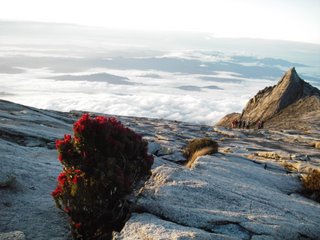
After a brief rest we continued to Low’s Peak (4095.1m), the biggest boy in the Kinabalu family. Hikers were descending as we approached. One of them conveyed that the view from the summit was obscured by clouds. Our late departure from Laban Rata had blessed us with a better sunrise after all. Dropping our packs at the base of the peak, we clamored up Low’s. We were the only one on it at this point. We owned the mountain, yet another stroke of luck caused by tardiness.
The hike up the slab had definitely been challenging. A full pack, not much sleep, the elevation…but I had made it without incident. It was on Low’s that I felt the effects of altitude sickness, a first for me. Though a bit difficult to describe, I’d have to say it's similar to being drunk, except it wasn’t fun. I became unbalanced, uncoordinated, unmotivated. My body breathed as deeply and fully as possible to no avail. Altitude sickness can happen to anyone regardless of age or how in-shape they are (unless of course they frequent high altitude locations). Soon I got a headache and became extremely fatigued. I wanted to take a nap, but we had come so far and were so close; I struggled onward.
Bagging the highest, albeit, with stairway-like access, possibly the easiest peak in SE Asia, was a reward in itself. The clouds around the summit had mostly cleared, the few remaining whipped around the mountains by powerful air currents. We could see all that we’d seen during the sunrise, plus the tops of the surrounding peaks: St. John’s, Victoria, Donkey Ears, South Peak. Low’s Gulley, with its smooth un-climbable granite walls and narrow water chutes gave a sense of two worlds: one windswept, dry and barren, the other sheltered, humid, and full of lush flora. We lingered on Low’s for the better part of an hour, taking pictures of each other and the surrounding landscape.


Descending to where we had left our bags, we trekked across the western plateau towards St. John’s peak, the second highest mountain in Kinabalu. This was much more off the beaten path, a privilege which required a multi-day/multi-peak pass and our billy goat guide. Traversing the western slope of St. John’s, we scrambled over loose rocks, holding onto any small shrub we thought would lend purchase. After what seemed like an eternity (the result of the altitude sickness no doubt), Taisung began leading us upward. As the route steepened, he went ahead, free solo-climbing the splintered slab in his five dollar shoes that made him look more like a skater boarder than a mountaineer. We watched impressed as he reached the top of the pitch, secured a rope he had brought, and dropped one end down to us. Taking turns, we ascended the rope climbing hand over hand, our feet locked firmly on the rock beneath (any slab climber out there knows the mantra: toe on, heel down, toe on, heel down). It wasn’t very difficult climbing, but I wouldn’t have attempted it without the rope. Once again, props to our guide. After all were safely at the anchor, Taisung repeated his dare devil feat and waited for us to climb up to the anchor. From this point on, we were able to hike and clamber our way up the ridgeline to the summit. Though the view from St. John’s was basically identical to that of Low’s, the peak’s loneliness, the lack of man’s mark, and the added challenging of ascending it, made bagging this peak feel like a much greater achievement on our part.
On our way back down, it started to rain. The persistent afternoon precipitation, rather than the sunrise, is the real guiding factor in Kinabalu hikers’ morning ascents. The otherwise coarse granite quickly became slippery in places. The two pitches that we had rope climbed now needed to be descended. Told by park staff headquarters that no climbing gear was necessary, we hadn’t brought our harnesses or ATC devices (used to belay other climbers and rappel). Half way down the first pitch, I think we all realized what bad advice we’d been given. Again, the slab wasn’t so steep, but the rock was now wet, the rope cold, our hands bitten by the wind. A body rappel was always an option, but this archaic method of wrapping the rope around oneself is hardly comfortable and not nearly as safe as the alternatives. Still, we survived.
Our feet back on semi-solid ground, it was now time to head to the West Gurkha Hut. Built in 1984 by a company of Gurkhas, West Gurkha Hut is the only lodging above Laban Rata. It’s used mostly by mountaineers and the occasional naturalist, the masses of tourists being ignorant of its existence. Kathlyn was research savvy enough to find this little gem, and I mean little. The hut was nothing more than a small A-frame, its roof about eight feet high. Though described as a room for four, it was a tight squeeze with three of us and our gear. Rain water was collected in a cistern outside. A rat lived under the cistern. A rat at almost 4000 meters…..unbelievable. A massive block of granite, Oyayobi Iwa, towered over our little hut. A rock strewn slab stretched out before it.

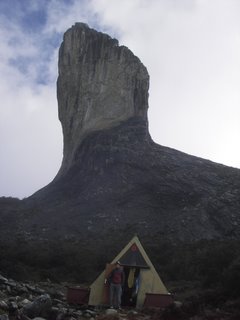
Exhausted, we unpacked. Taisung said goodbye; he would hike back down to Laban Rata and return the next morning weather permitting. We made an early dinner, some over salted ramen and canned tuna with crackers, and spent the rest of the day sleeping, reading, playing cards, and telling stories.
Day 3
A steady rain and hydration induced head ache, likely caused by the ramen and aggravated by a lack of oxygen, greeted me this morning. Two hours and a liter of water later, Taisung knocked on the door. We suited up for the morning’s summit, Victoria Peak.
Definitely the most challenging of the mountains we climbed, the steep slabs of Victoria were further compromised by the early morning showers. Again, a harness would have added piece of mind. After climbing several pitches using nothing but a saturated and frigid rope, we came upon a descending British climber and his Malaysian guide. He warned us of an impending traverse that required a rope, adding that his guide only used one after he vehemently insisted. Unlike us, he had brought a harness and some gear. Nervous about this, we hiked on. As we neared the top, Taisung draped our rope over a rock, saying we wouldn’t need it. We argued against this but he assured us it would be fine. And it was. I’m not sure what the Brit was going on about; the traverse was maybe ten feet across and only potentially perilous. We scurried through it without problem.
Victoria’s apex was narrow, rocky, and extremely windy. As with St. John’s large flakes of granite were stacked upon each other. Eyeing the fast moving clouds, we snapped a few victory shots, had a snack, and headed back down the mountain to our hut where Taisung once again took his leave.

Later that day it rained heavily and the plateau we were on turned into a series of fast moving creeks. Water even ran from behind and under the hut, exiting beneath the front door. We waited until about 4 o’clock and then went out hiking on our own. Working our way up and around massive pillar that towered over West Gurkha hut, we came upon the route leading to its top. Called Iyoyobi Iwa, it was by far the most interesting geological formation in the area. Already ahead of us due to his solid route finding skills, Dan was half way to the top when Kathlyn and I caught sight of him. Because of the narrowness of the route, Kathlyn and I waited at the bottom for Dan to return. He summited and then descended, advising us not to proceed. A certain move at the top, particularly on the descent, was scary and difficult even for him, a 5.12 climber (i.e. better than Kathlyn and I). “Hmmm…..free solo climb a wet route…..I've been doing the same the last day and a half, though that was on a slab……I’ll pass anyway.” Sometimes you have to know your limits.
Day 4
Once again arising early, we quickly packed up, swept the hut, and headed up the plateau to the base of Low's Peak where we'd meet Taisung and begin our descent. The sun had yet to rise, so we picked our way across the boulder field by head lamp, breathing as much of the oxygen-deprived air as we could. Just as the sun was rising, we reached Low's and met Taisung.
Though Taisung wanted to descend to Laban Rata and on to park headquarters, we decided it would be worthwhile to bag one more peak. South Peak is perhaps the most photograped summit on Kinabalu. Its gradually sloping ridgeline is set against the post card view of Sabah from nearly 4000 meters up. The peak itself often seems close enough to the clouds for one to be able to step on them. It would be a fitting end to an exciting three days, but it was not to be. Just meters from the top, a wind gust strong enough to knock a bull over, dominated the approach. Would it be worth the risk? Probably not.
We headed down. I hiked ahead, anxious to get to a restaurant that didn't serve a set menu of over-salted ramen and rain water. I have no memory of what I ordered upon arriving there, only that it was some of the best food I'd had in a long while.


